Joanna Oyediran reviewed The Amulet for Sudan Studies. Extracts from the review:
“The Amulet is a rare and moving memoir by Dr Hamid Dirar of his boyhood and coming of age amongst Hadendowa and Shukriya nomads in Eastern Sudan in the 1940s and 1950s, the story of a khalig ruhu, (a man who creates himself) – a term used by a Shukriya leader to describe one of Hamid Dirar’s maternal uncles, but equally, if not more, applicable to the author himself.” More than simply a memoir, the book commences with a detailed history of Hamid Dirar’s ancestors from the 19th century onwards. The first chapters explain how his father’s family, primarily Mahas from Nubia, were regularly forced to migrate, as a result of the Turco-Egyptian and British invasions and war between the Mahdists and the Jaaliyin, as well as pressure on the land.”
“A recurring theme is the prejudice directed against people deemed to have African physical features – frizzy hair, darker skin and broad noses. Hamid Dirar is more forthcoming on this sensitive topic than other Sudanese writers. Perhaps this is because as a child, he experiences such prejudice, particularly from his forceful maternal grandmother, Diya. She is disappointed with Hamid Dirar’s nose and skin colour, preventing his early circumcision, the defining feature of an Arab male.”
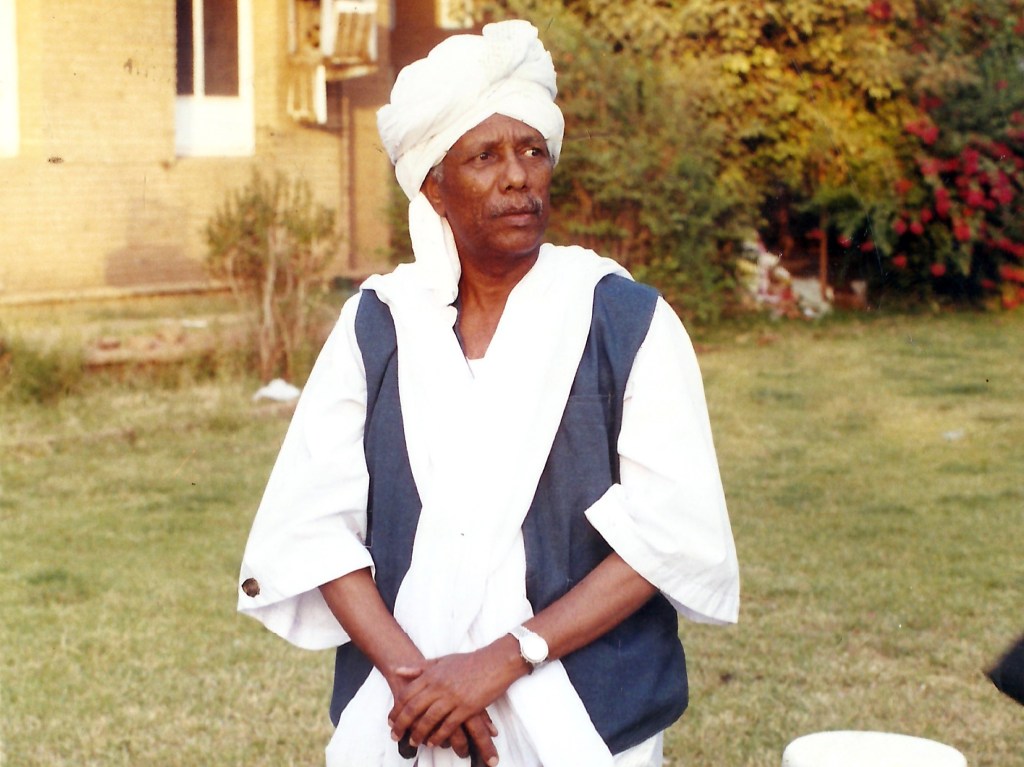
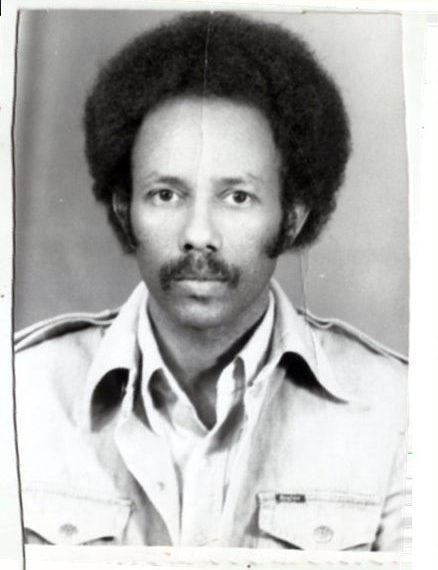
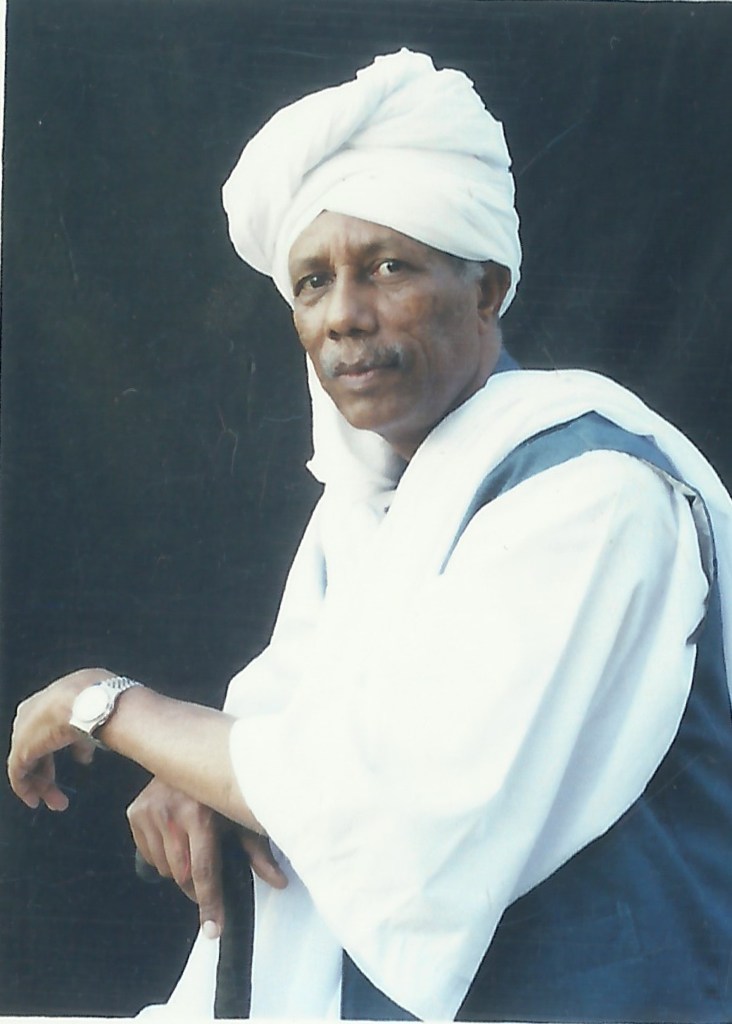
Hamid Dirar, Sudanese microbiologist, born 1940 in Wadi el Khireissab, Sudan, died 23 April 2023 in Khartoum.
Hamid Dirar was the most celebrated Sudanese scientist of his generation, a gifted writer who illuminated the lives of ordinary Sudanese – and his own remarkable upbringing – with profound knowledge, shrewd judgment and a lively wit. He died in April, after a long illness, at his home in Bahri – Khartoum North – just days after the current war in Sudan began.
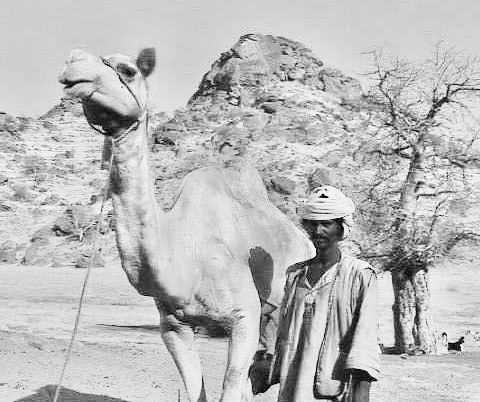
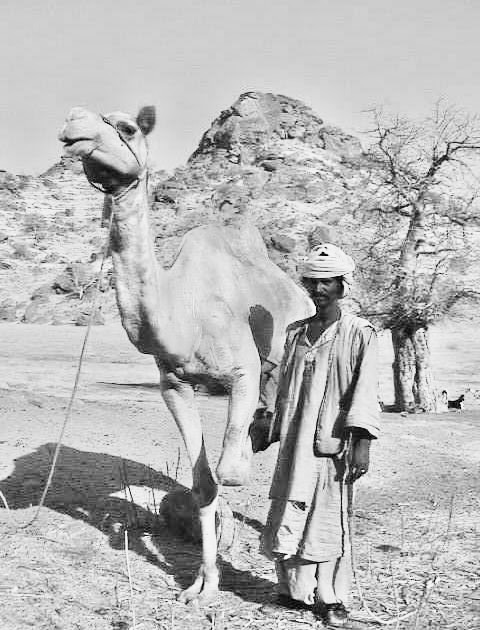
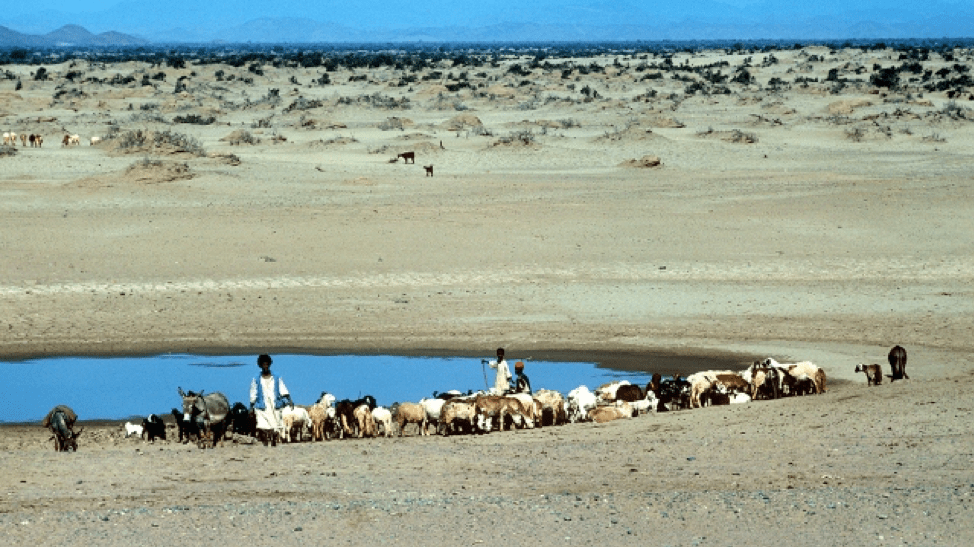
A microbiologist who had a distinguished career as a teacher and researcher in universities in the United States and Northern Ireland, as well as in his native Sudan, Hamid Dirar’s early life was as a barefoot camel nomad, son of a feki – a wandering religious teacher – in the remote grasslands and riverain forests near the Ethiopian border. His magnum opus, The Indigenous Fermented Foods of the Sudan (1993), is a book that combines explanations of the complex biochemistry of fermentation with an extensive hands-on understanding of indigenous food preparation and preservation across Sudan.
Based on many years of field research, and dedicated to the rural women of Africa, the book details the variations of fermentation and sun-drying used to preserve foodstuffs including sorghum, millet, dates, honey, milk, fish, meat, wild plants, caterpillars, locusts, fish, frogs and cow urine. It shows how these techniques had enabled generations to survive in a land visited by drought and famine. The book has been hailed by the Sudanese political analyst Magdi el Gizouli as “probably the most important book about Sudan ever written”.
The Amulet, published in 2022, is Hamid Dirar’s memoir of his upbringing in the Sudan-Ethiopia borderlands. The book has gained accolades from writers such as Abdulrazak Gurnah and Nuruddin Farah, who called it “a memoir of rare beauty”.
“It was my early existence as a nomad, harsh and sweet by turns, that made me what I am,” we are told in the author’s preface to The Amulet. ”Under my lab overalls, my early life in nomad encampments is inscribed on every part of my body: a dog’s bite; a scar left by the slash of a cutlass; and scores of cuts and burns intended to cure the illnesses of childhood”.
The world he was born into, Hamid Dirar writes, was far from centres of government, and had its own sources of authority. “It was a world lit by fire, where the old ways endured. We kept time by the seasons and by the rising and setting of the sun. A person was either young or old; years hardly mattered. Distances were measured in man-days, donkey-days, and – the longest – camel-days. Events in the wider world were recorded in the names of years: Sannat-Sitta, Year Six, the famine year of 1889. Or the year I was born, 1940, Sanat el Ganabil, the Year of Bombs.”
The final chapter of The Amulet describes an experience of state violence that is a grim precursor of present-day events in Sudan. Hamid Dirar’s student days in Khartoum coincided with the first of the military takeovers that have become a recurrent feature of Sudanese politics: the assumption of power by General Ibrahim Abboud. In 1964, following a student demonstration, covered in blood after a narrow escape from death, the author reflects on his experience:
“Back home in Shehateib the death of a single man by the sword was an event that might be discussed for a lifetime. His killer would be known. There, death always had a reason. But here, for the first time in my life, I saw men dying en masse, defenceless, for no reason at all. I had my first taste of what the military mentality, armed with a wealth of weapons, is capable of when it decides to bare its teeth. My limbs were stained with the blood of those I would never know.”
He continues: “The people of Sudan, I had learned from my study of the past – and from my knowledge of my own family history – had been subject to generations of violence, both from within and from without. Turks and Europeans introduced the weapons that had killed my student colleagues… Now Sudanese soldiers acting at the behest of an unelected leader, who had come to power on the back of a tank, had not hesitated to shoot down their fellow-citizens. It would only be when the men and women of my country were able to choose for themselves who should rule them that we would achieve true independence. Only then would Sudanese really be free.”
Hamid Dirar is survived by his wife Hanadi, daughter Maali, and two sons, Ammar and Ghassan.
Hamid Dirar’s The Amulet is reviewed in The Times Literary Supplement of 18 November 2023 by Robert Irwin, the novelist and scholar of the Arab world.
“The book is a mesmerising account of a childhood that was simultaneously paradisal and hellish,” writes Irwin. “Young Hamid was a barefoot nomad of the forests who rarely rode on camels or horses. He hunted on foot. He collected grasses and roots for meals. He learnt how to make waterwheels. He shepherded sheep and goats. In The Amulet, Irwin writes, Hamid Dirar chronicles his passage from his early life to ”the determined and learned adult who writes so compellingly about what it was like to be a wild boy.”
“The popular and unproblematic image of nomads.” he continues, ”is of tribes, such as those of the Arabs, Berbers or Mongols, who are united by blood and who either invade settled pastoral territory or follow a regular seasonal transhumant migration.” The Sudan of Hamid Dirar’s childhood, he explains, is more complicated: “Hamid’s background includes ‘ancestral strands from the Mahas people of Nubia, from the Jaaliyin of Shendi, and from the Shukriya of the Butana – and, by nurture, from the Hadendowa branch of the Beja people of Eastern Sudan’. ” In this milieu, writes Irwin, “it took a complex kind of human algebra based on knowledge of tribal ancestry, intermarriage, adoption and achievement to determine an individual’s status.
The review invokes Hamid Dirar’s account of nights in the nomadic encampments of his childhood. It was “a time when the old world was most present, when a group of youths might gather by the light of a wood fire and watch a religious elder reading the ground for signs of the unknown. Beyond them womenfolk would be watching, bare-breasted in the Hadendowa manner.” Hamid’s youth may have been paradisal in some respects, Irwin concludes, but it was a cruel paradise: “He does not spare the reader dispassionate accounts of circumcisions with stone knives, fights to the death, attacks by crocodiles and a wide range of strange and unpleasant diseases.”
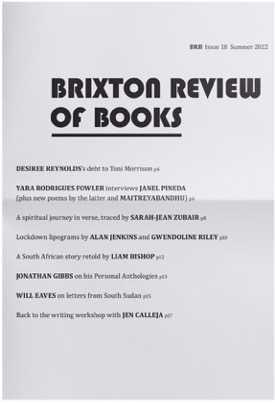
The summer 2022 issue of the Brixton Review includes a review by Will Eaves of Elizabeth Hodgkin’s Letters from Isohe. In his review, “Send Us To School”, he writes:
“Letters from Isohe is a frank and often stirring book: the strong element of reportage is intelligently close-quartered, so that small-scale triumphs and disappointments must stand in for the bigger problems of infrastructure in a contested state. At other times, the experience of reading it is unsettling, and immediate in a different, more personal way, as though one found oneself suddenly in receipt of bad news, holding a torn envelope, not knowing what to do… Most of these pieces were first published on the website of the Rift Valley Institute, and some editing has taken place, but they feel like real letters, which identify their recipients and compel them – us – to a distracted silence.”
Copies of the Brixton Review are free – if you can find them. But it may be easier to subscribe.
Neuromantics is a long-running podcast, hosted by the neuroscientist Sophie Scott and the writer and composer Will Eaves. Their conversations range across language, gesture, and other modes of communication in the arts and sciences. The current episode features a lively discussion of Liz Hodgkin’s Letters from Isohe. With their characteristic wit and sublimity, Will and Sophie locate the book in the long tradition of public letter-writing and witness-bearing.
An extract from their conversation: “The book memorably evokes the challenges of life in this beautiful but remote community. Food supplies falter, girls are forced into marriage, teachers’ salaries disappear, people die: but the village schools survive…. Hodgkin’s dispatches are responsive and informal; they bring us close, as only letters can, to the moment of witness…. that feeling of responsiveness has something to do with handwriting itself…”
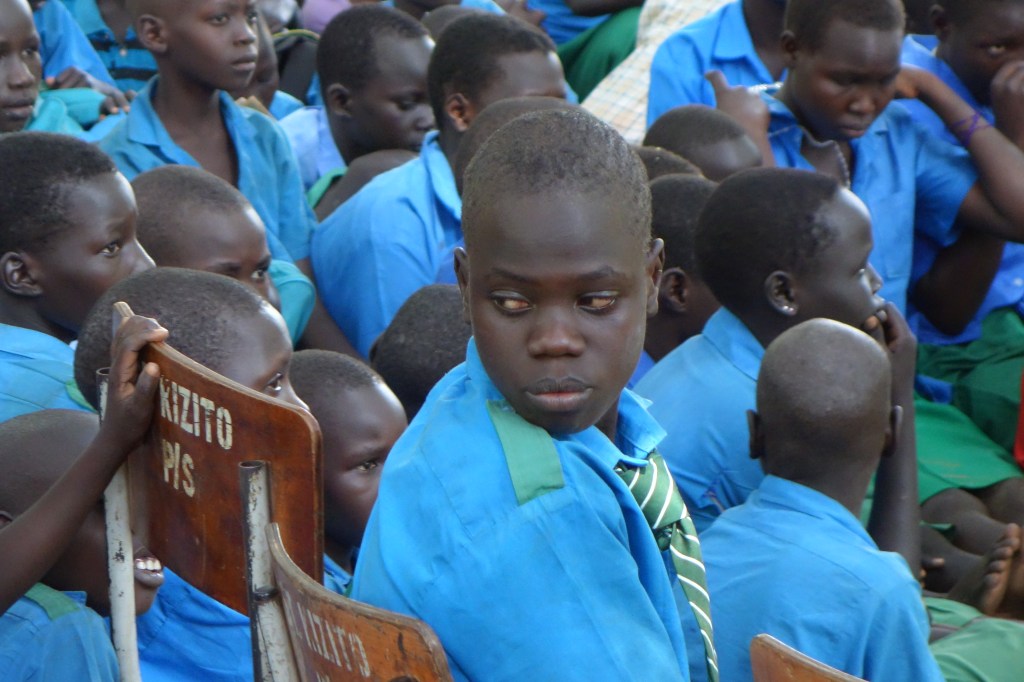
School assembly at St Kizito’s Primary School. Photograph by John Ryle.
At a launch event in March at SOAS (the School of Oriental and African Studies at London University) for Elizabeth Hodgkin’s Letters from Isohe£1000-plus was raised for education in South Sudan. Donations and proceeds of sales went to Opportunity Through Education (UK registered charity 1179046) to assist staff and students of St Augustine’s School in Isohe where Liz taught for eighteen months. The book is available now in paperback and e-book format.
The launch was a milestone for the author. In 2011, at the age of seventy, after a career as a human rights researcher in the Middle East and Africa, Liz Hodgkin went to teach in Isohe, in a remote mountainous area of Eastern Equatoria, in South Sudan. There she joined South Sudanese colleagues in the struggle to rebuild their communities after decades of war, teaching in a secondary school that lacked books and classrooms, where malaria and unreliable food supplies were everyday challenges.
Letters from Isohe is a collection of the letters home that Liz wrote to friends. The book has been a success even before it was launched, selling several hundred copies in the first few weeks. Liz’s clear-sighted, compassionate and humorous account of life at St Augustine’s School in Isohe strikes a chord with all who read it. Praised in South Sudan and worldwide, the book echoes with the voices of teachers, school-students, mothers, nuns and priests as they laugh, argue and discuss everyday life – elopements, pregnancies, hunger, guns, rain, cattle raids and local politics – and reflect on their future in a fractured nation.
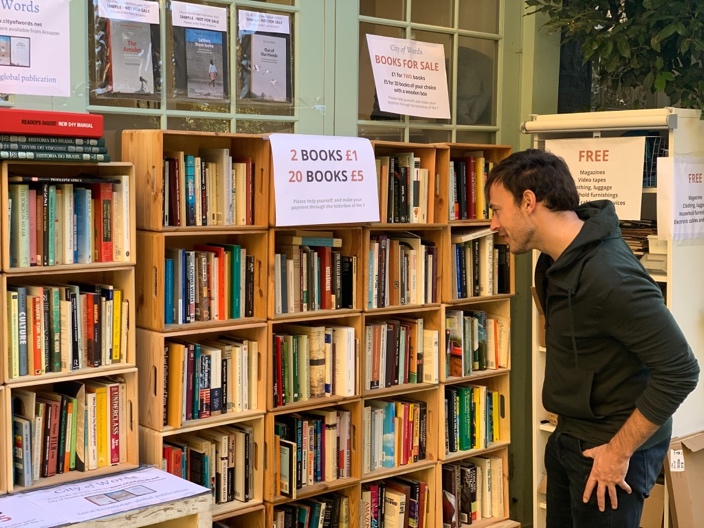
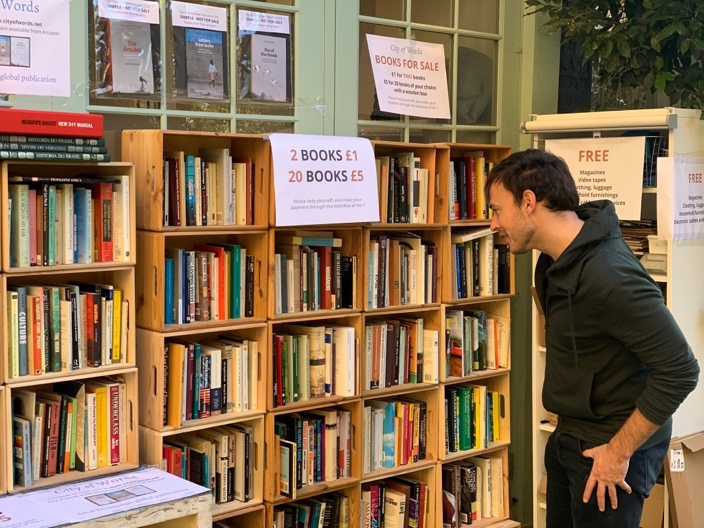
Recycling used books is City of Words’ side-hustle – on sale 24/7 in our open-air pop-up shop in West London, mostly in aid of the Dalgarno Trust, the local food bank. As long as the fine weather lasts the stall stays open round the clock, untended, a book night-market. The books are sold on trust; none have been nicked. (At 50p apiece they’re a steal anyway.) Some punters leave thank-you notes. And some of them, we hope, go online later to buy publications from City of Words.
Most of the books in the picture above are gone now, but stocks will be replenished soon. Any left unsold will be passed on to the Oxfam bookshops in Notting Hill for the benefit of other causes, doubtless at higher prices.
If you are in St Luke’s Mews, W11 and the weather holds, come and browse. You’ll find tourists taking selfies in front of the display; they may be under the impression that this is the bookshop that features in the movie Notting Hill. Visiting film stars are welcome.
Subscribe to the Newsletter to be advised of future City of Words events.
No one loves Amazon, but most people use their services if they live where Amazon operates. In the case of a niche publisher such as City of Words there are special reasons. For small-scale publishers sales and distribution are the main problem–the pons asinorum of the book trade – threatening an already fragile business model. This is particularly so in the case of City of Words because the readers of the kind of books we publish form a market that is scattered widely across the globe. Bookshops take a cut from sales that leaves little for the publisher; and in many places bookshops are few and far between. Fulfilling orders for books – whether it’s to supply shops or online customers – is time-consuming. Books are costly to ship, and maintaining stocks is irksome. Sales accounting is a headache. There’s no economy of scale.
And, for better or worse, consumers increasingly choose to buy books online. What Amazon offers a publisher – through KDP, an Amazon subsidiary – is an instant print-on-demand service in any country where they operate. This means that once a formatted PDF of a new book is uploaded by the publisher to the KDP website – complete with graphics and cover art – a customer anywhere can order a copy (they can preview the contents, if they like, using Amazon’s “Look Inside” feature). The book will be printed and bound – in the same country or region where it is ordered – and dispatched a day or two later. Or instantly, if it’s an e-book. Amazon take their cut, which is a variable percentage up to 50 per cent, then remit the remainder to the publisher’s account.
This arrangement means that we do not need to negotiate with printers, maintain stocks of books, fulfil orders, issue invoices, take payments or deal with returns. All this is taken care of by Amazon. We can see the details of sales and income on our KDP dashboard. The books are of good quality. In fact the print stock is better than that used in most trade paperbacks (though the boards – the covers – could do with more rigidity). Rights in the work remain with us and with the author, so we can print and sell copies independently if we want to. But mainly we don’t, because it makes no financial sense. Amazon gives us global reach and an easier life. That’s the reason why – at this point – they are our main point of sale.
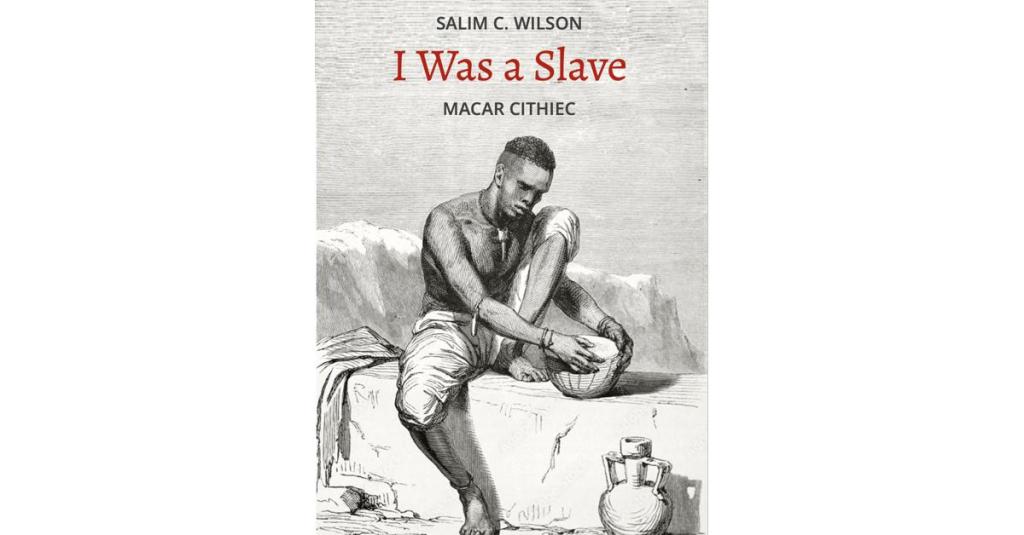
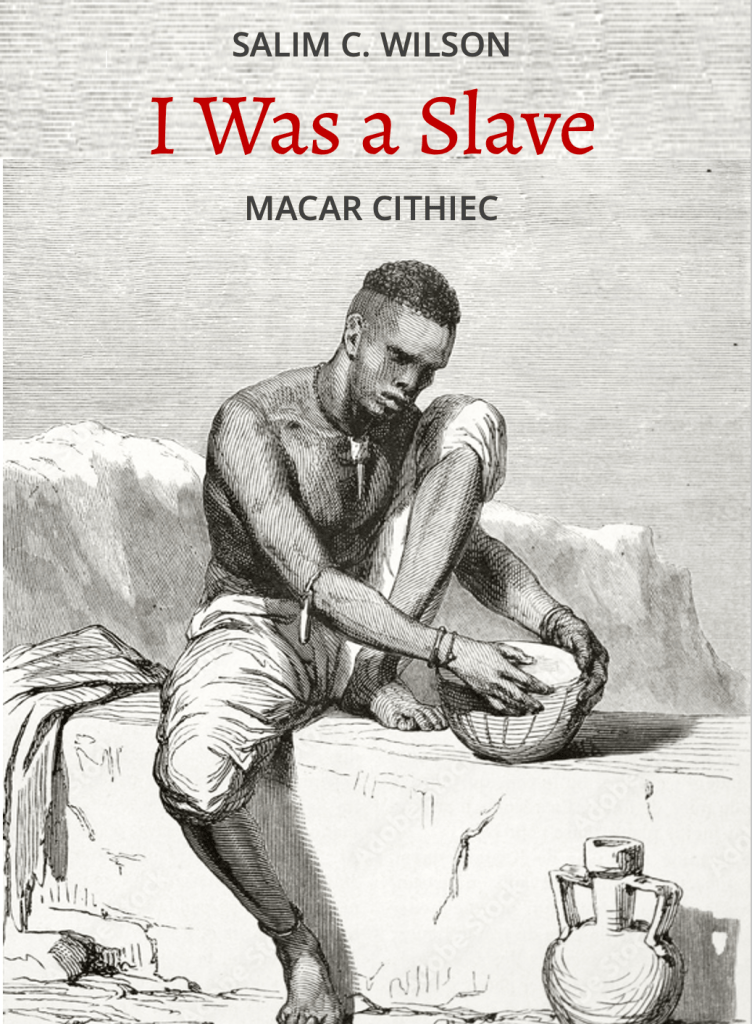
“The ground was scarred by fire. My father came to us with his leopard-skin torn and his ostrich plumes bent and broken, snatching up my brother and gripping me by the hand, taking cover in the glare of the flames. Our land was devastated, warriors slain, women and children carried into captivity, yoked like cattle…“
Forthcoming 2025
Born in what is now South Sudan, Macar Cithiec (Hatashil Masha Kathish) was taken in slavery as a boy and sold, as he wrote, “for six yards of calico”. Escaping captivity in the 1870s, he became one of the first from the south of Sudan to travel to Europe, taking the baptismal name Salim Wilson, and working as a Christian missionary and preacher in the north of England. He died in 1946. His autobiography, first published in 1933, is a testimony of human survival, a noteworthy document in the history of slavery and colonialism in eastern Africa. Republished for the first time with maps, a glossary, and a new introduction by John Ryle and Joseph Diing Majok.


 cityofwords.net